Hailey Woods Photography
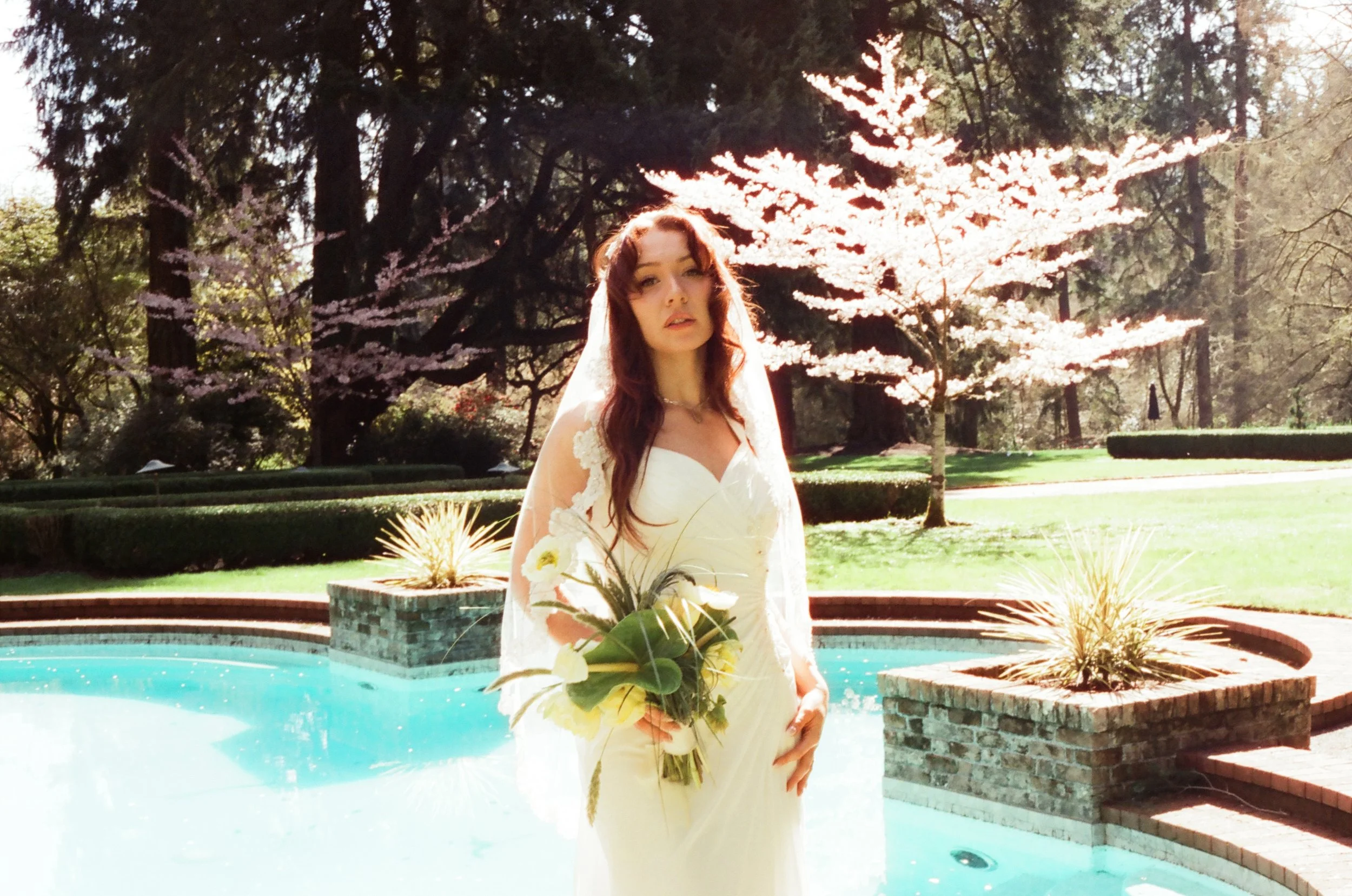
Green and white bridal bouquet for a Greek-inspired bridal portrait shoot
I have recently gone semi-viral. The video was to help couples have a ballpark idea of how much their Pinterest designs would actually cost. Oh boy, I pissed some people off. I’d be lying if I said I wasn’t irritated as well. Here I am, trying to be helpful, and all these other florists start DM-ing me that I priced everything too low and telling customers what the wholesale cost of flowers are contributes to the ever growing problem of couples wanting flowers for cheap. Woah, hang on. I was explaining how I follow industry standard markups and labor charges, and that florists making a profit is actually okay because we are businesses, and that’s kind of, like… the entire point of having a business.
I’m not saying any information that isn’t readily available on the internet, there’s no secret to how florists price their work. You might not know where to look, but it’s there. So, here’s a real list of the wholesale prices per stem that I pay here in Seattle for flowers in those incredible designs on Pinterest vs. what the retail cost is for my business.
Anthurium - Wholesale - $8-$16 / Retail - $24-$48
Hanging Amaranthus - Wholesale - $4 / Retail - $16
Calla Lily - wholesale - $3.50 / Retail - $10.50
Dahlia - wholesale - $1.75-$3 / Retail - $5.25-$9
Hydrangea - wholesale - $2-$8 / Retail - $6-$24
Phalaenopsis Orchid - wholesale - $55 / Retail - $165
Basically, the more unique the flower, the more expensive, the more temperamental, and time consuming it is. If you haven’t caught on to the pattern yet, the algorithm is wholesale cost x3. Then, florists can either include an additional 30%-50% labor charge in each arrangement, or altogether as it’s own item - that’s what I do - but the labor charge is a nonnegotiable. When I price out arrangements, that’s the formula I follow, because that is the standard across the industry. Some lovely florists decades ago figured out that’s what is needed in order to keep your business running, and that is the expectation. I want to keep doing this. I don’t want to have to have two jobs forever, so my business has to be profitable so I can make money to survive. You will always find people who can do it cheaper than this formula, but usually they are just starting in the industry.
I am not afraid to share everything about my business, because I know where every penny goes. 25% spent on flowers. 25% set aside for taxes. 20% paying freelancers. 10% paying for overhead - could be more if the florist has a studio - rent, water, electricity, gas, etc. 7% new inventory and mechanics. 3% marketing budget. 10% to pay me. These aren’t hard-set rules, but it is what I aim to set aside from each event.
People think that florists are scammers. People think we’re charging whatever we’d like. That’s not the case, 90% of our money is used to keep our business running. As I get more experience in the industry, I might have a higher labor charge, because, yes, of course I want to make money doing this. I love flowers. I love everything about planning a curated vibe for each couple that matches them. But I want to also be able to take a vacation once in a while, or take myself out to eat a nice dinner. I’m not ashamed about making money as a business. I’m not ashamed to tell exactly what I paid for the flowers vs. what I charge my clients. Because I think that kind of transparency builds trust. Trust that I’m not going to run off with your money. Trust that the money you’re spending is getting you your money’s worth in flowers. Trust that your florist’s labor is worth it. Look back at what I budget for each event, 72% of the budget is going to flowers, labor, and mechanics. The rest is literally just taxes and paying for marketing so someone else can book me and I can be in be in business for longer than 2 years.
The reason florists make it hard to access prices is because they think that getting luxury clients is dependent on not mentioning money at all. But what I think is, that’s bullsh*t. Everyone has a budget. It doesn’t matter if it’s $100,000 or $100 million. A budget is a budget. Everyone wants to know what their money will get them, and nobody wants to think they’re getting scammed. See, I don’t think that me joining into the luxury market is dependent on being afraid to talk about money. I treat every client that I have the exact same, regardless of if they’re paying for $8,000 in flowers, or $30,000. A simple, “here is what you’re looking for will cost, are there any edits you would like to make?” Neutral. I do not view any budgets in a positive or negative way. This is the money we have to work with, and I do my best to stick to that. The only things I care about are making sure I deliver 110% of what we agreed upon, and that booking my services is as smooth as possible. My process feels hands-off, I designed it that way. I want my clients to know that if they book me 14 months ahead of their wedding date, they don’t need to keep checking in, I won’t bombard them with messages. It’s a consultation, potential edit meeting, and a 2-month check in. That’s it. I want to take something off of my clients’ plate, so they have one less thing to worry about discussing between themselves, or with their planner.
Weddings are inherently luxury events. They cost a lot of money to host. But that doesn’t mean I have to make my life harder and hide my prices from inquiring couples. That just frustrates everyone involved, I’m sad that I have to have a conversation about the fact that the beautiful, full, double-sided arch isn’t doable for $2,000, and they’re upset that the wedding flowers they thought would cost $5,000 are actually more like $40,000. Nobody’s happy in this situation. I will continue to share my prices publicly, despite it being frowned upon.
Do I need to share what I pay per stem? No.
I don’t care though. I pay $8 for an Anthurium, so that’s the price that I remember. I’m not the customer, I’m not paying $48 per stem, so I’m not going to say they’re $48 because for me, they’re not. Also? it’s fun. it’s fine. it doesn’t matter. I’m not a huge conglomerate company that pays their employees nothing while I make millions. I won’t be treating my business as such. I pay my freelancers a living wage, and I pay myself a living wage based off of the hours dedicated to each wedding. My clients will be happy to know that they not only are getting amazing, artistic flowers, they’re putting their money into a place they can trust to pay their workers well, and to not pollute the environment to an insane degree with each event.
Maybe I made a mistake on my math in the video, it was a 15-minute-quick-math estimate of prices and I threw it together thinking it wouldn’t go anywhere. oops. I’ll pay more attention to the math and make sure people’s expectations are fitting reality of my business. How another florist prices something, I can’t attest to.
Ashtyn
